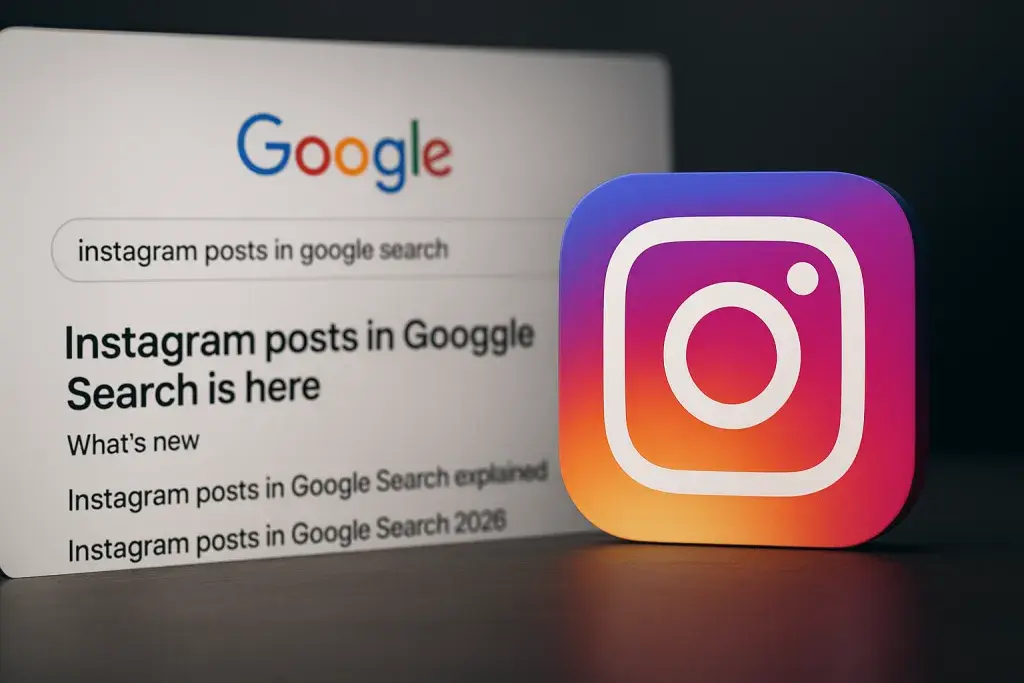
Type a brand name into a browser search bar right now, and there's a decent chance a public Instagram post shows up alongside the usual results. That's not a glitch or a temporary test. It's a deliberate shift in how visual content surfaces outside the app, and it's already reshaping the way people find creators, products, and profiles they'd otherwise have to search for manually inside Instagram itself.
For years, Instagram content stayed mostly locked behind its own walls. A post might get thousands of likes, but unless someone shared the direct link, it stayed invisible to anyone browsing the web through traditional means. That barrier is coming down. Public posts, including images and captions, can now surface in general web results, which means accounts with consistent activity and genuine engagement suddenly have a new discovery channel working in their favor. This also means the accounts that already have a solid follower base and active engagement patterns are positioned to benefit first - which is part of why services like boost me instagram have seen renewed interest from creators trying to strengthen their profile before this kind of visibility becomes standard practice.
What follows is a full breakdown of what changed, why it happened, and what it actually means for anyone posting on Instagram going forward. Whether you're trying to understand the mechanics or figure out how to adjust your content strategy, the details below will give you a clear, practical picture.
What Is the Instagram Posts in Google Search Update
At its core, this update means that certain public Instagram posts can now appear directly in general web search results, not just within Instagram's own search bar. Previously, finding a specific post required either following the account, using a direct link, or scrolling through a profile manually. Now, a post with the right visibility settings and enough public engagement can show up when someone searches related terms, even if they've never opened Instagram that day.
This is what people mean when they talk about instagram posts in google search explained in plain terms: public content is being indexed and surfaced the same way a blog post or news article might be. The account doesn't need to do anything unusual to qualify - it simply needs to be public, active, and relevant to whatever someone happens to be searching for.
- Public posts, including photos and carousels, can now appear in general search listings.
- Thumbnails and captions may show up alongside the post link.
- Profile links are often included, making it easier for new visitors to jump straight to an account.
- Indexing appears to favor posts with stronger engagement and clearer captions.
How This Differs From Previous Instagram Visibility Online
Before this update, Instagram content lived almost entirely inside its own ecosystem. A post could technically be public, but that didn't mean it was easy to stumble upon outside the app. Hashtag pages, explore feeds, and direct shares were the main ways people found new content. Web crawlers largely skipped over Instagram's internal pages, treating them as closed systems rather than open web content.
| Aspect | Before the Update | After the Update |
|---|---|---|
| Visibility outside the app | Very limited, mostly through shared links | Public posts can appear in general search results |
| Discovery method | Hashtags, explore feed, direct follows | Direct search queries, even without following the account |
| Content indexed | Rarely indexed in a structured way | Posts, captions, and sometimes thumbnails indexed |
| Access requirement | Often needed an Instagram account or app | No account needed to view indexed results |
The contrast is significant. A small bakery that posted a photo of a new pastry last year had almost no chance of that post surfacing outside its follower base. Today, that same kind of post has a real shot at appearing when someone searches for that bakery by name, even if they've never followed the account.
Why Instagram and Search Platforms Made This Change
This shift didn't happen in isolation. Visual content has become one of the most common ways people look for information, whether they're checking out a restaurant menu, comparing products, or trying to see what an event actually looked like. Platforms that keep valuable content locked away risk losing relevance as users increasingly expect visual answers to show up wherever they search.
- Growing demand for visual and image-based search results across the web.
- Competitive pressure from other short-form and visual platforms pushing for wider content distribution.
- A push toward making public social content more discoverable rather than isolated within a single app.
- An opportunity to drive new traffic back to Instagram from people who weren't previously active users.
This is very much instagram posts in google search news worth paying attention to, because it signals a broader trend: social platforms are becoming more comfortable letting their public content live outside their own walls, as long as it still drives traffic and engagement back to the source.
How Instagram Posts Appear in Search Results
The practical experience of seeing Instagram content in search results is fairly straightforward once you know what to look for. A result might show a small thumbnail image, a portion of the caption, the account name, and a link straight to the post or profile. It looks similar to how a news article or product page might appear, just with a distinctly visual, social feel.
Not every post qualifies. Content needs to be public, and there appear to be some threshold factors related to engagement and relevance that influence whether a post gets indexed and how prominently it appears.
- Standard public photo posts are the most commonly indexed content type.
- Carousel posts can appear, often showing the first image as the preview.
- Reels have more limited and less consistent visibility compared to standard posts.
- Stories, due to their temporary nature, are generally not indexed at all.
| Content Type | Appears in Search Results? | Notes |
|---|---|---|
| Public photo post | Yes | Most consistently indexed format |
| Carousel post | Yes | Usually shows first image as preview |
| Reels | Sometimes | Visibility appears less consistent |
| Stories | No | Temporary format, not indexed |
The process behind this works in stages. A post gets published, the account's public status allows it to be crawled, the caption and image data get processed, and over time, if the content is relevant enough, it starts appearing for related searches. A local photographer posting a portfolio shot with a descriptive caption and location tag, for example, stands a much better chance of appearing in a relevant search than someone posting a photo with no caption or context at all.
Privacy Settings and Who Can Be Indexed
Only public accounts are affected by this change. If an account is set to private, its posts remain invisible outside of approved followers, regardless of how this update evolves. That said, many users assume their content is more private than it actually is, simply because they don't post frequently or don't think of their account as widely followed.
- Check account privacy settings directly rather than assuming based on follower count.
- Review individual post visibility settings if available.
- Remember that once a post is public and indexed, removing it later doesn't guarantee it disappears from search results instantly.
Anyone uncomfortable with this level of exposure should treat their account privacy settings as an active decision rather than a default they never revisit. A public account today behaves very differently than a public account did a year ago.
What This Means for Creators, Brands, and Marketers
For anyone using Instagram professionally, this update changes the calculus around content strategy. Visibility no longer depends solely on followers or the algorithm inside the app. It now also depends on how well a post can stand on its own as a piece of indexable content, complete with a clear caption, relevant context, and genuine engagement.
- Write captions that clearly describe the content rather than relying on vague or purely stylistic text.
- Use alt text thoughtfully, since it may contribute to how content gets classified and surfaced.
- Post consistently rather than sporadically, since indexing tends to favor active, established accounts.
- Focus on authentic engagement, since accounts with genuine interaction patterns tend to perform better in visibility terms.
| Content Habit | Likely Impact on Visibility |
|---|---|
| Descriptive, keyword-relevant captions | Improves chances of appearing in relevant searches |
| Inconsistent posting schedule | Reduces indexing frequency and overall reach |
| Strong, genuine follower engagement | Signals relevance and can improve visibility |
| Vague captions with no context | Limits how well the post can be matched to searches |
A strong follower base and steady engagement rate now carry weight beyond the app itself. An account that's already built genuine momentum, whether organically or with the help of tools like account growth services, tends to be better positioned once that content starts appearing in places it never used to reach.
Instagram Posts in Google Search 2026: What to Expect Next
This rollout is still evolving, and the version available right now likely isn't the final form. Based on current patterns, it's reasonable to expect broader availability across regions, more consistent indexing of Reels, and possibly deeper integration with other discovery features tied to visual and image-based search.
- Wider geographic rollout as the feature moves beyond its initial testing regions.
- More consistent treatment of video-based content like Reels alongside static posts.
- Potential new signals tied to account credibility or engagement quality influencing visibility.
- Closer integration between social content and broader visual discovery experiences.
None of this is guaranteed, and platforms often adjust these rollouts based on user behavior and feedback. Still, anyone building a presence around instagram posts in google search 2026 should plan with the assumption that visibility outside the app will only continue to expand, not shrink.
Common Mistakes and Things to Watch Out For
As with any instagram posts in google search update, there's a gap between understanding the change and actually adjusting behavior around it. Several avoidable mistakes show up repeatedly among users and creators trying to make sense of this shift.
- Assuming every public post automatically gets indexed the moment it's published.
- Ignoring privacy settings and being caught off guard when older posts appear unexpectedly.
- Neglecting captions and alt text, which limits how well content can be matched to relevant searches.
- Expecting an immediate surge in traffic rather than a gradual increase over time.
- Confusing this update with general profile-level visibility, when it specifically concerns individual post indexing.
Avoiding these missteps mostly comes down to treating public Instagram content the same way you'd treat any other public content online: intentional, well-described, and consistent.
Questions and Answers
Does this update apply the same way in every country?
Rollouts like this typically expand gradually rather than launching everywhere at once. It's worth checking current behavior directly by searching your own account or content to see whether it appears, since availability can vary by region.
Can I stop my Instagram posts from showing up in search results?
Switching an account to private prevents public indexing entirely. For accounts that want to stay public but limit exposure on specific posts, checking individual post visibility options is the most direct way to manage this.
Do Instagram Stories and Reels show up the same way as regular posts?
No. Stories are temporary and are not indexed at all, while Reels appear inconsistently compared to standard photo and carousel posts. Static public posts remain the most reliably indexed content type.
Will this change how I should write my captions?
Yes, to some degree. Clear, descriptive captions give indexed content more context, which likely improves how well a post matches relevant searches compared to vague or purely stylistic text.
Is this the same as my whole profile appearing in search results?
Not exactly. This update concerns individual public posts being indexed and surfaced, whereas profile-level visibility is a separate matter tied to how discoverable an account itself is when someone searches a username or brand name.
How do I know if my posts are already appearing in search results?
The simplest way is to search your own brand name or a distinctive phrase from a recent caption and see what comes up. If a post appears with a thumbnail and link, it's already part of this indexing behavior.