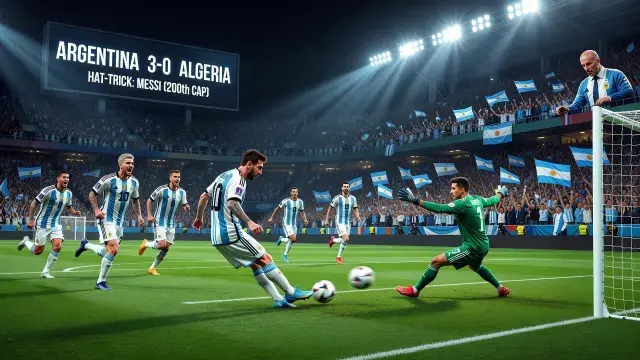
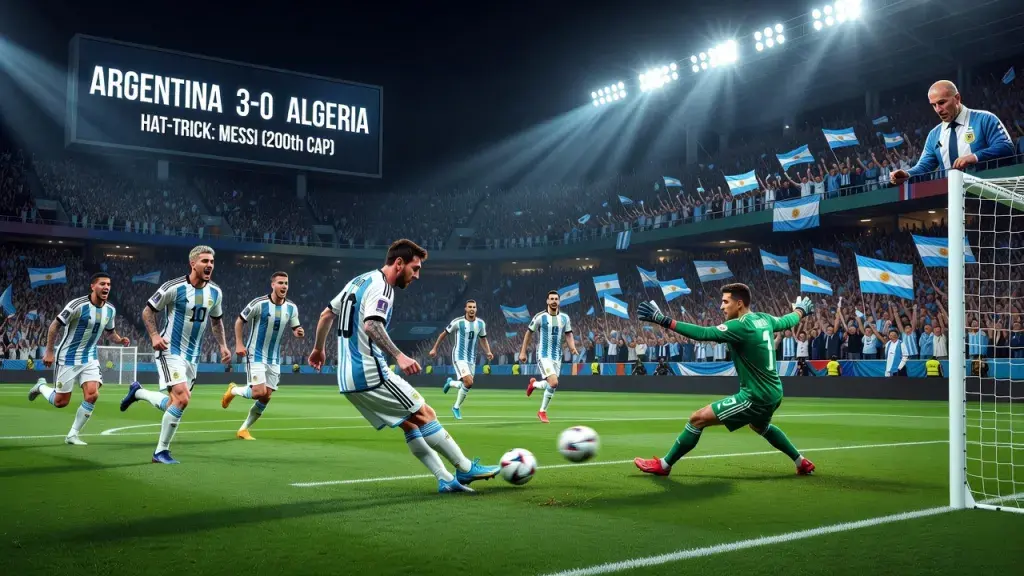
Twenty years to the day after a floppy-haired teenager came off the bench and scored against Serbia at the 2006 World Cup, Lionel Messi stood in the Kansas City Stadium and delivered a hat-trick against Algeria that left the football world struggling for superlatives. Argentina's holders opened their title defence with a 3-0 victory, and once again, the story belonged entirely to one man. It was Messi's 27th appearance across six World Cup editions, his 200th cap for Argentina, and another reminder that the question of when he will stop producing moments like this remains stubbornly unanswerable.
The occasion carried the kind of layered symbolism that tends to attach itself to Messi's career whether he courts it or not. Algeria's goalkeeper was Luca Zidane - son of Zinedine - while the 1998 World Cup winner with France watched from the stands as Messi dismantled his son's team with clinical efficiency. For those tracking football's long arcs and generational handovers, it was the sort of detail that feels almost too neat, much like the way long-term sporting markets - whether horse racing ante post betting or football tournament outright markets - tend to eventually reward those willing to back an enduring champion well in advance. Algeria, appearing at a World Cup for the first time since 2014, were respectable opponents on paper; on the pitch, they were overwhelmed.
Messi's first goal was a fierce left-footed drive from outside the penalty area. His second came from sharp instincts at close range, pouncing on a rebound before any defender could react. His third was drilled into the bottom corner from the edge of the box - composed, precise, inevitable. Three different types of goal, all carrying the same signature. He has now scored more goals from outside the penalty area at a World Cup than any other player since 1966, drawing level with Brazil's Rivellino on five. The records, as ever, piled up without any apparent effort on Messi's part to collect them.
A Night of Records That Messi Doesn't Even Know He's Breaking
At 38 years and 357 days, Messi became the oldest player to score a hat-trick in World Cup history, overtaking Cristiano Ronaldo, who was 33 years and 130 days old when he scored all three of Portugal's goals in a 3-3 draw with Spain at Russia 2018. He also surpassed Cameroon legend Roger Milla to become the oldest player to score more than once in a single World Cup match. Former Argentina strikers Carlos Tevez and Sergio Aguero, on commentary duty, literally bowed.
The record that may matter most historically is still to come. Messi needs to score in Argentina's next group game to become only the third player - after France's Just Fontaine in 1958 and Brazil's Jairzinho in 1970 - to find the net in six consecutive World Cup appearances. He is on five, a streak that includes all four of Argentina's knockout-stage matches at Qatar 2022. Rodrigo De Paul, his club team-mate at Inter Miami and closest ally in the Argentina camp, offered the most illuminating insight into how Messi relates to all of this: "I swear to you, he doesn't know, he doesn't care. Sometimes we're there drinking mate and we'll say to him: 'Hey shorty, you're one or two goals away from a record'. He has no idea. Sometimes we prod Leo to see if he can break records, and he ends up doing it."
Messi's Rivals Pay Tribute as a New Generation Watches On
Tuesday produced a remarkable backdrop for Argentina's opener. Earlier in the day, Kylian Mbappe - who shared a dressing room with Messi at Paris Saint-Germain from 2021 to 2023 - scored twice as France beat Senegal 3-1, including a stunning long-range effort. Erling Haaland also scored twice on his debut at a major international tournament, helping Norway to a 4-1 win over Iraq. Both men have spent years being positioned as Messi's successors. Both spent the evening paying tribute to him instead. Haaland posted a crown emoji on social media with the caption: "Messi is a madman." Thomas Muller, who scored 10 goals in 19 World Cup matches for Germany, posted an image of himself facing Messi in MLS and called him the greatest of all time.
Carli Lloyd, a two-time Women's World Cup winner with the United States, captured something important on X: "Messi is playing with complete freedom. He's already achieved the ultimate goal by winning the World Cup, and that makes him even more dangerous this tournament. No pressure or expectations to live up to - just pure football." Algeria captain Aissa Mandi, whose side were methodically taken apart, was gracious in defeat: "He might be the best player of all time. We tried to shut him down as much as possible, but it didn't work." Riyad Mahrez, speaking on beIN Sports, was more concise: "They've got Messi. That made the difference."
A Champion Playing for the Joy of It
Argentina head coach Lionel Scaloni, not a man given to overstatement, admitted he was at a loss: "I don't have the words to describe Messi. For 20 years, he's had us used to seeing things like this, and he inspires everyone who watches him play." De Paul added a telling observation about the man behind the records: "What makes me happiest is that he's enjoying it. He's not carrying this weight he carried for so long. He's good, he's happy, and I think that's contagious in the group."
Messi himself, when asked to reflect after the game, was characteristically understated: "Everything I'm experiencing now is a bonus. I've been fortunate enough to achieve all my dreams - or even more than I ever dreamed of. Now I'm just enjoying this, being part of a wonderful group, feeling good and being able to enjoy it out on the pitch. This is far more than I could ever have imagined when I was a kid." The boy who scored his first World Cup goal on June 16, 2006, is now 38, holds more records than he can keep track of, and is still, somehow, the most compelling footballer on the planet.