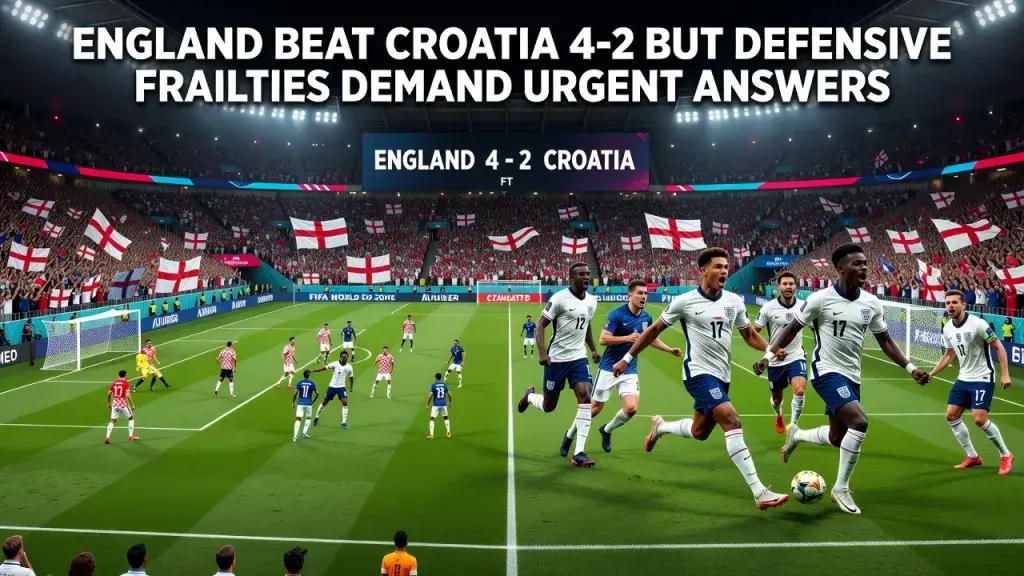
England opened their FIFA World Cup 2026™ campaign with a convincing 4-2 victory over Croatia, but the scoreline flatters to conceal a more complicated story. The Three Lions dominated the second half in emphatic fashion, yet the same defensive vulnerabilities that have haunted England through successive tournaments resurfaced in ways that will concern Thomas Tuchel and his staff ahead of tougher tests to come.
The match unfolded in two distinct halves. The first 45 minutes were closely contested, with neither side establishing clear superiority - a reminder that Croatia, despite their fading generational peak, remain a structured and technically capable opponent. Just as England appeared to be managing the game into the interval, they conceded. Mário Pašalić found space in a dangerously exposed midfield zone, calmly picked his moment, and delivered an assist that Ivan Perišić converted with a header. It was a preventable goal, the kind that football analysts - much like those who might just as easily spend an evening deciding whether to bet on floorball or dissect a centre-back's positioning error - could identify in real time: no pressure on the passer, a defensive line too passive, and a gap that should never have existed at this level. The warning was costly and entirely avoidable.
The second half belonged to England almost entirely. Tuchel's side came out with sharper intent, quicker combinations on both flanks, and a pressing intensity that Croatia could not live with. The statistics underline the dominance: 13 shots in the second period, every single one taken from inside the penalty area. This was not England scattering efforts from range and hoping; it was a team systematically dismantling a defence and finishing with purpose. Few sides at this World Cup can point to that level of penetration as a consistent feature of their play.
Squad Depth Proves Its Worth
Perhaps the most encouraging signal for England was not what their starters produced, but what their substitutes delivered. The fourth goal encapsulated the point perfectly. Bukayo Saka came off the bench and immediately injected pace down the flank before creating the opening for Marcus Rashford to finish. Both players - the provider and the scorer - had entered as substitutes. With the five-substitution rule now firmly embedded in the modern game, the ability to shift the dynamic from the bench is no longer a secondary consideration; it is a genuine tactical weapon. England possess it in abundance. Saka, Rashford, Morgan Rogers, and Morgan Gibbs-White represent a calibre of replacement option that very few squads at this tournament can match. The depth is real, and against Croatia it was decisive.
Tuchel's tactical flexibility also drew positive attention. Some of his substitutions provoked debate in the moment - deploying Reece James to reinforce the midfield was a choice that divided opinion - but the outcome vindicated the German coach. A 4-2 win over a side of Croatia's experience and organisation is not a routine result, and Tuchel deserves credit for reading the match correctly in the moments that mattered.
The Defensive Problem Has Not Gone Away
Strip away the attacking output, however, and England's defensive performance carries the same familiar fault lines that have followed this team from the Gareth Southgate era into the present. The recurring pattern - lead, retreat, surrender control - was visible again here. When England go ahead, their shape drops, their midfield line retreats, and opponents are gifted time and space they have no right to enjoy at this level of competition.
Croatia's second goal was not a moment of individual brilliance from the opposition. It was a structural failure. The English defence sat too deep, the midfield offered no pressure on Pašalić, and the result was a composed assist followed by an unmarked header. The principle that a centre-back must control the space behind them - not merely the zone in front - was violated, and Croatia punished it without needing to do anything extraordinary.
The central defensive partnership of John Stones and Ezri Konsa remains uncertain. Stones endured an injury-disrupted club season at Manchester City, and his physical sharpness over a full tournament campaign remains an open question. Konsa, meanwhile, has not yet commanded the unconditional confidence of those who watch England closely. Both were exposed by Perišić's movement, and both will face significantly more dangerous forwards as the competition deepens. The suggestion that Marc Guéhi - outstanding at Euro 2024 - may offer greater reliability is one Tuchel will need to consider seriously. Even Harry Kane, England's captain and focal point of the attack, was drawn back into defensive duties late in the game, a sign that Jordan Pickford's backline was under genuine pressure even while the scoreline appeared comfortable.
A Winning Start, But the Work Is Not Done
England's victory over Croatia is the ideal opening to any World Cup campaign. The attacking threat is genuine, the squad resources are exceptional, and the second-half performance offered glimpses of a team capable of going deep into this tournament. But reaching a World Cup final requires eight matches across roughly forty days, and the defensive fragility on show here cannot be managed away by scoreline alone. Tuchel has the tools. The question is whether he can address the structural problems quickly enough, before opponents of greater quality than Croatia find a way to exploit them at a moment that costs England everything.