Jannik Sinner is not playing his best tennis at Wimbledon. He does not need to be - not yet, anyway. The world No. 1 and defending champion dispatched Jan-Lennard Struff 7-5, 7-6(4), 6-3 on Wednesday to reach the semifinals, where Novak Djokovic could be waiting under an 87-degree London sky on Friday. Sinner's baseline game remains out of sorts, but his serve has become something close to an impenetrable weapon, and on the grass of the All England Club, that may be enough.
The broader sporting week has seen its share of high-stakes knockouts across multiple competitions - fans tracking the morocco round of 16 2026 world cup atlanta storyline will understand what it means to arrive at the decisive stage of a tournament needing one more performance to justify everything that came before it. Sinner finds himself in a similar position: the hardware is there, the ranking is there, the reputation is established, but the question hanging over SW19 is whether the full version of the Italian returns before the trophy is presented. Against Struff, he hit 16 aces, landed 65 percent of his first serves, and won 84 percent of those points. More telling still, when Struff did manage to get his return over the net and in play, Sinner won 69 percent of those exchanges - the best conversion rate among remaining players in the draw.
A Weapon Refined Over Years, Tested in the Heat
Sinner's serve was not always this formidable. The transformation traces back to 2022, when he switched from a platform stance - feet apart at the start of the motion - to a pinpoint stance, feet coming together before the jump. The adjustment allowed him to leap higher and drive down through the ball with greater authority. The results were immediately evident. At the 2024 Australian Open, Djokovic - the finest returner of the modern era - could not conjure a single break point across their four-set encounter, the first time that had happened to him in a five-set match. The serve was the primary reason.
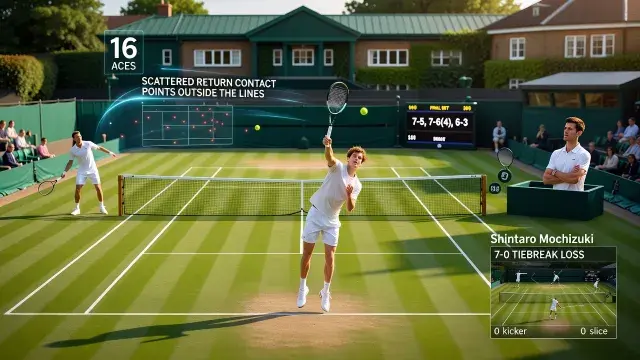
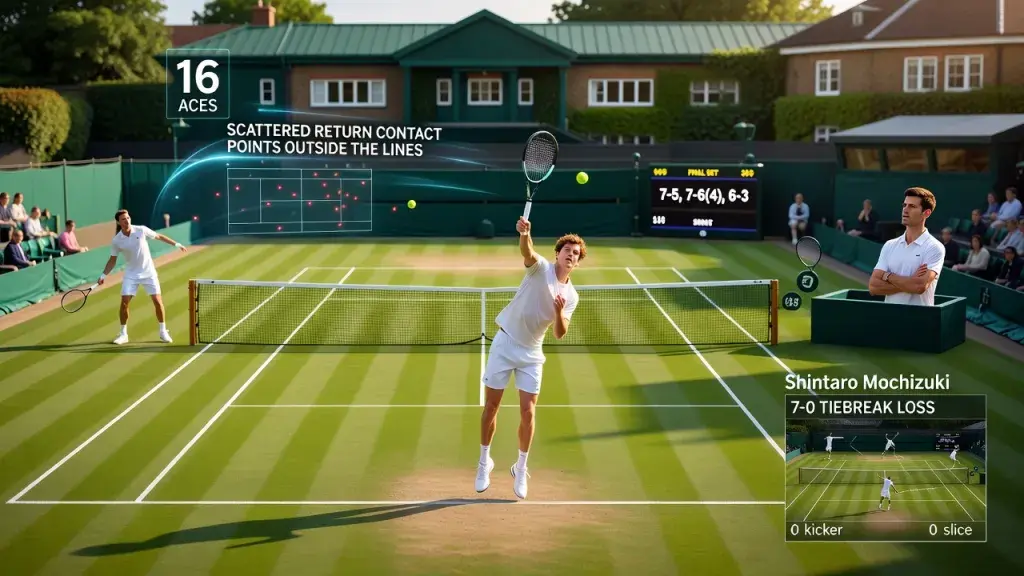
At this Wimbledon, the numbers are exceptional. Across four matches, Sinner has struck 81 aces. His first-serve percentage sits at a consistent 66 percent, and he is winning 85 percent of those points. More than half of his successful first deliveries go unreturned entirely. A scattergraph of opponents' contact points when returning his serve shows a cluster of dots outside or barely inside the tramlines - he rarely targets the body, and his opponents are consistently caught on the edge of the court, off balance, unable to generate any meaningful pressure before the point is essentially over.
The Blueprint Against Mochizuki - and What It Revealed
The clearest demonstration of how decisive this weapon has become came in the fourth round against Shintaro Mochizuki, the world No. 151 from Japan. The first set was comfortable, done in 33 minutes. The second set moved toward a tiebreak, which on the surface suggested a contest. It was not. Sinner served on just three of the seven points in the tiebreak and won them all - an ace, a kicker to the T that pushed Mochizuki onto the back foot, then a slice out wide that Mochizuki dumped into the net. He won the tiebreak 7-0. Overall in that set, he won 24 of 28 points behind his first serve, landing over 70 percent of them. On 17 of 38 service points across the match, he did not need to play a second shot. "He served well, so I couldn't break any games," Mochizuki said afterward. "That cost me a lot."
Sinner himself acknowledged the pattern, though with characteristic restraint. "I felt like I was serving well at times, especially important moments today," he said. "That helped me also being a bit more freer in the return games." The logic is straightforward: a dominant serve reduces the pressure on every return game, because a single break can be comfortably defended. Sinner is banking on that dynamic to carry him through the semifinals and, if needed, a final - even if his baseline game has not clicked into the gear that made him near-unbeatable on clay earlier in the season, when he won in Monte Carlo, Madrid, and Rome in succession.
The Heat Question and What Lies Ahead
The one variable that cannot be aced away is the weather. Sinner cramped and withdrew from his third-round match at the French Open against Juan Manuel Cerúndolo, and while he initially deflected questions about the role of heat in that exit, he later acknowledged - in London two weeks before Wimbledon began - that it was a genuine issue requiring preparation. He and his team have prioritised hot-weather training ahead of the tournament. Against Struff, with temperatures climbing, he held firm. "We did a good preparation," he said. "Whatever happened in the past, it's gone already. Now we see if we found a solution. If not, we keep working for the next one."
Friday's semifinal against Djokovic, likely to be played in full afternoon heat, will test that preparation directly. The 24-time Grand Slam champion knows Sinner's game intimately - and Sinner knows his. The serve will matter enormously on grass, where the ball skids and stays low and a clean winner off a first delivery is always within reach. Sinner enters with the statistics, the confidence, and the experience of having won this title before. Whether the rest of his game rises to meet the occasion, or whether the serve alone shoulders the entire load, will define the next 48 hours at the All England Club.